
The Technology Was Right. The Investors Still Lost.
Sep 17, 2026
What If the Technology Is Right, But the Investment Is Wrong?
There’s a story I remember hearing many years ago that has stuck with me throughout my 17 years in markets. It was about electricity, and the basic idea was that you could have correctly identified one of the most important technological changes in history and still ended up with a disappointing investment if you paid the wrong price at the wrong point in the cycle.
I wanted to go back and fact-check that story because it feels particularly relevant to what we are seeing today. The exact version I remembered, that electricity stocks bought at their peak went on to underperform the market forever, isn’t quite right, but the actual history is arguably just as interesting. By the late 1920s, investors had become incredibly excited about the electrification of America. Between March 1928 and September 1929, listed utility stocks outperformed the broader market by more than 80%, and some valuations became extraordinary. Electric Bond and Share, one of the major utility holding companies of the era, reportedly traded at around 96 times earnings.
Then the cycle turned. From the 1929 peak through 1932, the utility sector lost more than 75% of its inflation-adjusted total return value. Even a decade after the peak, the real total return index for utilities was still roughly 55% below where it had been in 1929. What makes that statistic so interesting is that electricity itself continued to spread throughout the economy. More homes were connected, industrial usage expanded and electricity eventually became one of the foundations of modern economic life.
That has always been one of my favourite lessons from market history. The investors were not necessarily wrong about electricity. In many ways, they weren’t bullish enough about what the technology would eventually become. What they got wrong was the relationship between the future potential of the technology and the price they were willing to pay for the companies building it.
GRAPH 1: U.S. ELECTRICITY UTILITY STOCKS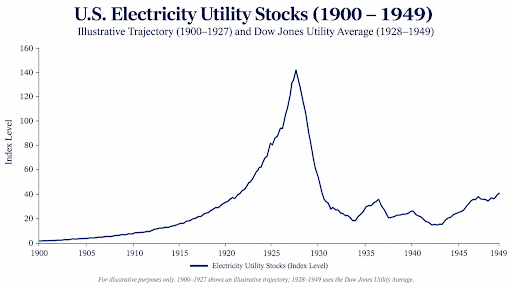 Caption: U.S. Electricity Utility Stocks. Source: DJUA history, Wikipedia.com / fxevolution.com
Then We Did It Again With the Internet
Fast forward roughly 70 years and we saw another version of the same story with the internet. Again, the technology was real and ultimately became considerably bigger than many investors at the time could have imagined. If you had told someone in 1999 that within 25 years we would carry the internet around in our pockets, stream television through it, run businesses through it and spend hours every day connected to it, you would have sounded incredibly bullish.
Yet many of the companies responsible for building that future became terrible investments from their peak valuations. One of the clearest examples is Lucent Technologies, which is why I think the chart below is worth looking at again today.
GRAPH 2: LUCENT TECHNOLOGIES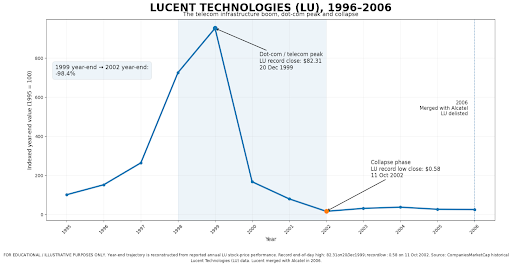
Caption: Lucent Technologies was a story of a massive IPO, boom and then spectacular bust. Source: As per image.
The Boom Then Bust
Lucent was one of the giants of the telecom infrastructure boom. At its peak around the end of 1999, its market value had reached roughly US$260 billion and its shares traded above US$80. Less than three years later, the stock traded below US$1. The internet hadn’t disappeared during those three years, and the long term demand for connectivity hadn’t disappeared either. In fact, global internet usage would go on to explode.
What had changed was the financial structure supporting the boom. Enormous amounts of money had been spent laying fibre and building telecommunications networks, often based on assumptions about future demand that were extremely optimistic. Capital was readily available, debt was being issued and companies were competing aggressively to build capacity before somebody else did.
This is where the story gets particularly interesting for me, because equipment manufacturers weren’t always simply selling equipment to their customers. In some cases, they were also helping those customers finance the purchases. Lucent was one of the companies doing this, as was Cisco.
SEC filings from the period give us a good example of how this worked. One telecom operator had access to a financing facility of up to US$315 million from Lucent specifically to purchase and install Lucent equipment and services. The same company also had access to as much as US$120 million from Cisco Systems Capital to finance purchases of Cisco telecommunications equipment.
There is nothing inherently unusual or improper about vendor financing. It has existed across many industries for a very long time. But from an investor’s perspective, it changes the question slightly. Instead of simply looking at how much equipment is being sold, you also want to understand where the money ultimately came from to pay for that equipment.
GRAPH 3: SEMICONDUCTORS
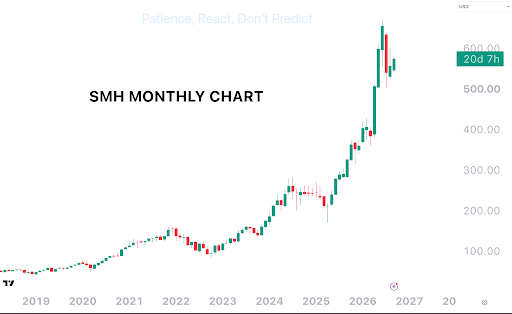
Caption: Semiconductors have had a great run in recent years. Source: TradingView / fxevolution.com
Which Brings Me to AI
I want to be very careful with the comparison here because I’m not saying Nvidia is the next Lucent, nor am I saying AI is simply another telecom bubble. History rarely repeats that cleanly, and there are major differences between the businesses, their profitability, balance sheets and the technologies involved.
What interests me is something more fundamental: the flow of money around the AI ecosystem is becoming increasingly complicated.
Semiconductor companies sell GPUs to cloud providers. Cloud providers provide computing capacity to AI companies. AI companies enter enormous infrastructure agreements. Technology companies make investments into AI companies, while private credit and bond markets provide capital for data centres. Those data centres then require more GPUs, more networking equipment, more cooling and increasingly enormous amounts of electricity.
If you step far enough back, you can start to see why some investors have begun asking questions about the circularity of parts of the ecosystem. A semiconductor company can invest in an AI company, the AI company can spend money with a cloud provider, the cloud provider can use that demand to justify additional data centre investment, and those data centres ultimately require more semiconductor equipment.
None of those transactions automatically makes the demand artificial. Each investment or commercial agreement can make perfect sense on its own. But I think the system level question is becoming more important: how much of the growth throughout the ecosystem is ultimately being financed by capital coming from elsewhere inside that same ecosystem?
That is where I think the telecom history becomes useful, not because it tells us that AI has to end the same way, but because it reminds us to look beyond the headline revenue numbers and understand how the infrastructure is actually being financed.
What If AI Really Does Change the World?
This is probably the part of the discussion I find most interesting. What if the bulls are largely right about AI? What if AI agents become commonplace, robotics expands rapidly, almost every major company incorporates AI into its operations and global demand for computing continues growing for another decade?
AI could become considerably larger than it is today and that still wouldn’t automatically tell us whether every dollar being spent on infrastructure today will generate an adequate return, or whether every company exposed to that buildout is correctly valued.
That was the lesson from electricity. The technology transformed the world, but investors who bought some utility shares at extreme valuations still experienced enormous losses and a very long recovery. It was also the lesson from telecom. Internet traffic exploded exactly as the bulls expected, yet Lucent still went from one of America’s largest companies to a stock trading below US$1.
This is something I’ve learnt to appreciate more the longer I’ve been in markets. Being right about the direction of technological change and being right about an investment are two different things. Price matters, financing matters, competition matters and, perhaps most importantly during infrastructure booms, the return eventually earned on all that capital matters.
The Chart I Keep Coming Back To
This is why I keep coming back to the Lucent chart. Not because I expect Nvidia or any other AI company to follow the same path, but because it shows what can happen when a genuine technological revolution meets enormous infrastructure spending and equally enormous expectations.
The internet won. Demand for data exploded and much of the infrastructure built during the telecom boom eventually became essential. But that didn’t necessarily make the companies building it good investments at any price.
As the AI infrastructure buildout continues, I think the more interesting questions are increasingly about the financial plumbing underneath it. Who is funding the data centres? Who carries the debt? How much capacity is being committed years in advance, and how much of the spending ultimately traces back to capital circulating within the same ecosystem?
History doesn’t tell us where this cycle ends, but it does help us ask better questions. AI may well change the world, just as electricity and the internet did. The lesson from both is that being right about the technology and being right about the investment can be two very different things.
Make sure to check out our featured courses.
Until next week,
Patience. React, don’t predict.
Thomas Atkinson
CFTe | FXE Trading Academy
Trading financial products carries significant risk. The information provided is educational in nature and does not constitute financial advice.
References
Please verify the exact source links and chart credits before publication.
See more articles like this.
Stay connected with news and updates!
Join our mailing list to receive the latest news and updates from our team.
Don't worry, your information will not be shared.
We hate SPAM. We will never sell your information, for any reason.
